Jornaya LeadiD and TrustedForm on inbound calls: how a web-form record reaches the phone
A Jornaya LeadiD is a unique ID created when someone lands on a web form page. A TrustedForm certificate is a record issued when someone completes a form. Both are consent records: evidence of what a person saw and did on a page.
A phone call carries neither one. Here's how a record made on a form reaches an inbound call, where a litigator scrub fits, and who keeps the record.
This is general education, not legal advice.
What is Jornaya LeadiD?
A LeadiD is the ID Jornaya's script creates for a visitor's session on a form page. People also call it a Jornaya token.
The LeadiD Create page says the ID is generated "the moment a customer lands on a webpage where our Create script is installed". From there, the script "witnesses their interactions and collects data related to their experience".
Older pages still pair Jornaya with Verisk. On 8 January 2026, ActiveProspect announced it had acquired Verisk Marketing Solutions. The post says that unit was "formed primarily through the combination of Infutor and Jornaya".
TrustedForm and Jornaya: a token, a certificate, one owner
TrustedForm is ActiveProspect's own consent product. Its product page says "For every consumer that completes a form, TrustedForm issues a certificate for each lead generated."
The certificate documents "the exact landing page, timestamp, and consent language shown". It's shared through a web URL.
The difference that matters is timing. A LeadiD starts when the visitor lands on the page. A certificate comes from a completed form.
So a LeadiD on its own tells you a session began. Whether the visitor finished the form is something to check in the record itself.
ActiveProspect now owns both. Its announcement states no plan to merge or retire either one.
Which should you collect? Start with your buyer's lead spec, the written terms for the leads that buyer will accept. If it names one, send that one.
Why a phone call breaks the chain
A consent record lives on the web. A phone call reaches you with a caller ID and the number dialed, and nothing about a form.
So the record has to be sent with the call, as data. There are three routes to ask about:
- A ping or post from the publisher. A publisher is the traffic source sending you calls. A ping is a request that carries lead data before the call connects. The post follows it. See what is ping-post.
- A lead posted before the call. The publisher sends the form data first, token included, and the call follows.
- The page that shows the number. Dynamic number insertion is a script that swaps the phone number on a page, so it can pick up values from that visit. TrackDrive's help article says query-string values are "stamped onto the resulting Call record as tokens", and custom tokens you configure are "also captured". No TrackDrive page says a LeadiD goes this way.
Every route has the same gap. A LeadiD shows a form session. On a call, you're relying on the publisher's word that this caller is the person from that form session.
Why collect a record for a call someone placed themselves? Your buyer's terms may ask for it, and you may call or text that person later. Whether consent rules reach a given call is a question for your counsel.
How a LeadiD travels with a call in TrackDrive
TCPA stands for the Telephone Consumer Protection Act, a US law that restricts telemarketing and automated calls and texts. TrackDrive's pages state steps 2 to 4 below one at a time. None spells out how a token in a ping becomes the record captured on the call. Confirm the mapping when you set it up.
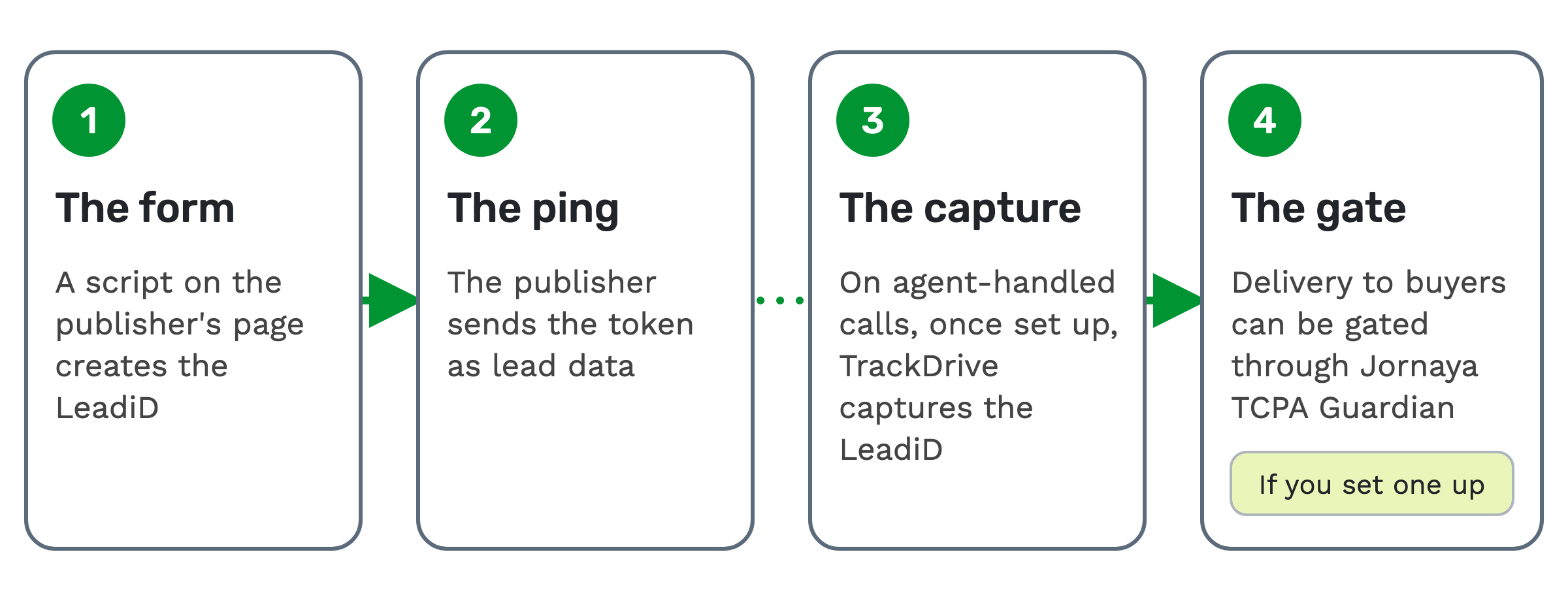
1. The form. A script on the publisher's page creates the LeadiD.
2. The ping. The publisher sends a ping containing "the lead data buyers bid on (state, vertical, jornaya token, and so on)", as the ping-post guide puts it.
3. The capture. On agent-handled calls, when a Jornaya campaign ID is set up, TrackDrive captures the LeadiD.
4. The gate, if you set one up. TrackDrive "can gate delivery to buyers through Jornaya TCPA Guardian so leads that don't meet your configured TCPA requirements are not connected".
Capturing and gating are separate steps, and you configure the requirements. The legal notice quoted in full below, written for your outbound program, says these tools "do not, on their own, guarantee compliance".
TrackDrive's consent page names only Jornaya: it says nothing about capturing or gating on a TrustedForm certificate.
Two help articles on posting call data to and from Ringba do show a trusted_form_cert_url field. Their examples pass
it the same way as jornaya_leadid.
TrackDrive also handles the opposite signal on text messages. "Inbound STOP / unsubscribe / cancel keywords are detected and honored automatically". That opts the contact out and records what the page calls "an immutable opt-out log".
TCPA litigator scrub: a blocklist, not a consent record
A TCPA litigator scrub compares a phone number against a list of numbers linked to people who often file TCPA claims. A match can keep that caller away from your buyers.
It does a different job from a consent record.
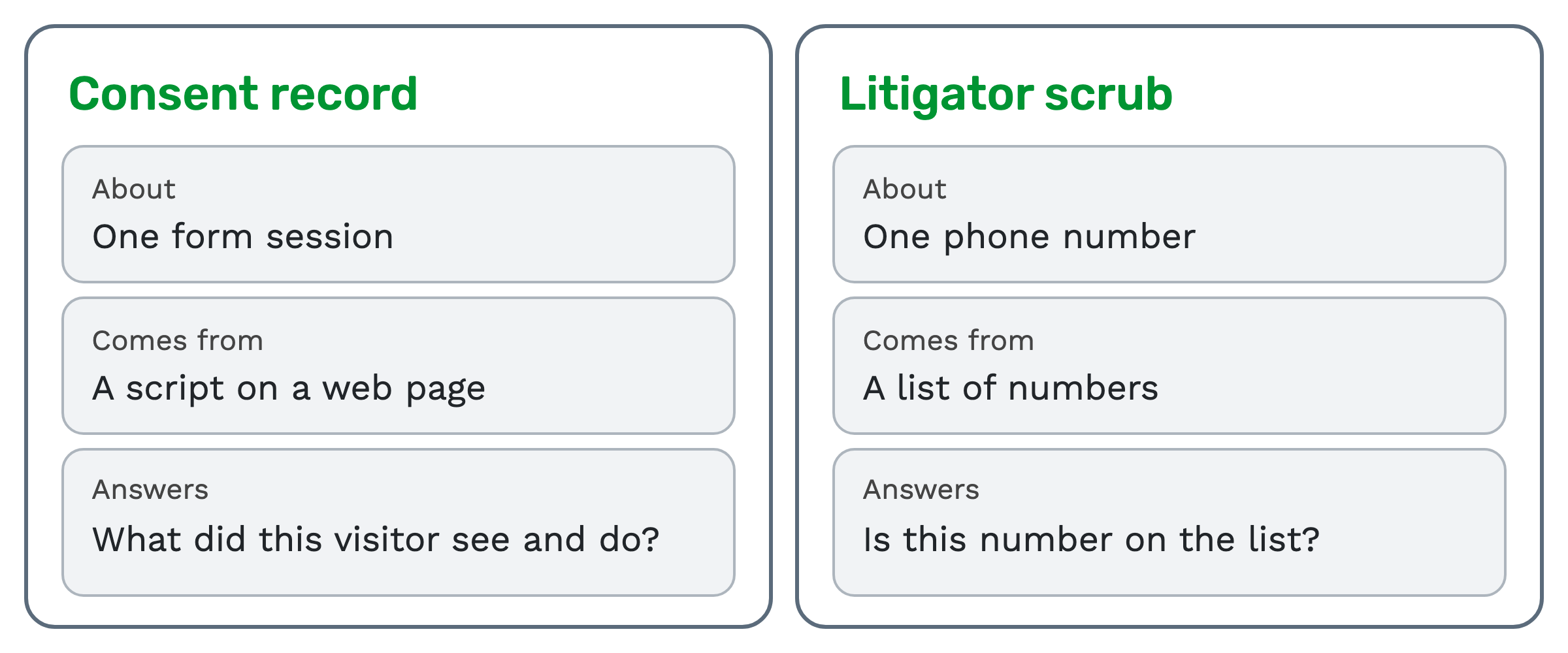 A consent record is about one form session. It comes from a script on a web page, and it answers: what did this visitor
see and do?
A litigator scrub is about one phone number. It comes from a list of numbers, and it answers: is this number on the list?
So a clean scrub says nothing about consent, and a consent record says nothing about the list.
In TrackDrive's ping-post, a ping is checked against DNC only when the offer has DNC rejection turned on. It's off by default. DNC stands for Do Not Call. A suppression list is a set of numbers excluded from a buyer, offer or schedule.
TrackDrive's ping-post page carries no legal notice of its own. The suppression and DNC page, in a notice about "your outbound calling and messaging program", says its tools "do not, on their own, guarantee compliance". It also says you are solely responsible for configuring them and for complying with the law.
TrackDrive's checks on outbound calls fail closed: if a lookup can't be completed, the number is treated as blocked. The page says that about outbound dials only.
If you connect a litigator service that bills per lookup, ask how a check on every ping would be billed.
One limit to know: TrackDrive doesn't pre-check leads against the federal Do Not Call registry; scrub your lists before import. Call scrubbing covers the list side.
You keep the record, not the platform
TrackDrive's consent and opt-out page carries this notice, quoted in full:
The above tools help you operate your outbound calling and messaging program; they do not, on their own, guarantee compliance. You are solely responsible for configuring these controls and for complying with the Telephone Consumer Protection Act (TCPA), the FTC Telemarketing Sales Rule (TSR), all applicable FCC regulations, and any other applicable federal or state telemarketing and consumer privacy laws. The TrackDrive Platform is a real-time communications routing system and is not designed or guaranteed to serve as a permanent or long-term repository for call recordings, transcriptions, call logs, or consent records. You are responsible for exporting and securely storing all telephony, audio, and consent data in your own systems — including before any automated PII redaction — to satisfy your record-keeping obligations. TrackDrive assumes no liability for the loss, auto-deletion, redaction, or unavailability of data stored solely within the Platform. This overview does not constitute legal advice. Read the Platform Services Agreement (Sections 2.3.6, 2.3.7, and 2.6) for full details.
Its first line speaks of your outbound calling and messaging program, and it's quoted here as written.
The same page says Data Exports let you pull its audit logs into your own systems on a recurring schedule. Export before any PII redaction runs.
TrustedForm has its own clock. ActiveProspect's Retain page says certificates are "deleted after 90 days unless retained", and that Retain holds them for up to 5 years.
What to ask a publisher who sends you a token
- Which record do you send: a LeadiD, a TrustedForm certificate, or both?
- On which page was it made, and when?
- How does it reach me: in a ping, in a post, or from the page?
- How do you tie this caller to that form session?
- Who stores the record, and for how long?
The answers won't settle the legal question. They tell you what you actually hold.
Questions people ask
What is a Jornaya token? Another name for the LeadiD. It's the value a publisher sends with a ping or a lead.
Is it Jornaya or Journaya? Jornaya. "Journaya" is a misspelling.
How much does Jornaya cost? No public Jornaya price list turned up on 9 Nov 2026. One 2026 comparison says "Jornaya publishes nothing and sells on negotiated annual contracts". TrustedForm's Retain page lists per-unit rates.
Do I need both a LeadiD and a certificate? Your buyer's lead spec decides. Neither one replaces a litigator scrub.
Does a LeadiD show the caller agreed to this call? It records a form session. Whether that covers this call is a question for your counsel and your publisher.
See it in action
Request a demo for a live walkthrough tailored to your use case, or start free, with no credit card and no onboarding fee.